03 February, 2023 3 min read
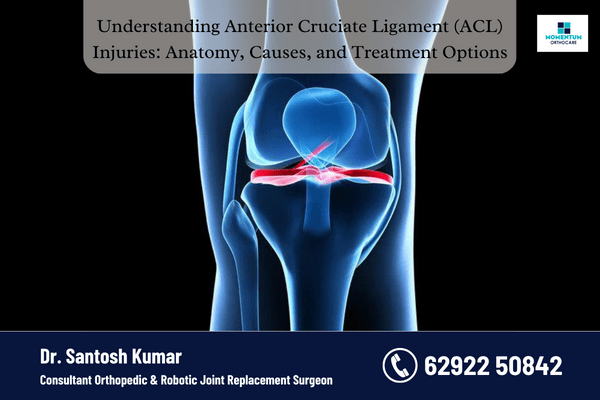
One of the Best Orthopedic Doctors in Kolkata Dr. Santosh Kumar talks about ACL Injury. The anterior cruciate ligament (ACL) is a vital structure in the knee that connects the femur to the tibia. It provides stability to the knee joint and helps prevent excessive forward movement of the tibia relative to the femur. Unfortunately, ACL injuries are quite common, particularly among athletes and active individuals. In this blog, we will discuss the anatomy and function of the ACL, the common causes of ACL injuries, and treatment options for ACL injuries.
Anatomy and Function of the ACL
The ACL is a strong, fibrous band of tissue that runs diagonally through the knee joint, from the back of the femur to the front of the tibia. It is one of four major ligaments in the knee and is responsible for preventing excessive forward movement of the tibia relative to the femur, as well as rotational instability of the knee joint. The other three ligaments are the posterior cruciate ligament (PCL), medial collateral ligament (MCL), and lateral collateral ligament (LCL).
The ACL is made up of two bundles of collagen fibers: the anteromedial bundle (AM) and the posterolateral bundle (PL). The AM bundle is tight in knee flexion and lax in extension, while the PL bundle is tight in extension and flexion. This arrangement allows the ACL to provide stability throughout the full range of motion of the knee joint.
Common Causes of ACL Injuries
ACL injuries can occur as a result of a variety of factors, including sports-related injuries, falls, and accidents. Some of the most common causes of ACL injuries include:
- Sudden stops and changes in direction: Sports that involve sudden stops and changes in direction, such as basketball, soccer, and football, put athletes at a higher risk of ACL injuries.
- Landing incorrectly: Jumping and landing incorrectly can cause the knee to buckle, putting stress on the ACL.
- Direct impact: A direct impact to the knee, such as a tackle in football or a collision in basketball, can cause the ACL to tear.
- Overuse: Repetitive stress on the knee joint, such as running, can lead to ACL injuries over time.
Treatment Options for ACL Injuries
Treatment for an ACL injury depends on the severity of the injury and the patient’s individual needs. Some of the most common treatment options for ACL injuries include:
- Rest and rehabilitation: For minor ACL injuries, rest and rehabilitation may be sufficient to allow the ligament to heal independently. Physical therapy can help strengthen the muscles around the knee joint and improve the range of motion.
- Bracing: A knee brace can provide support and stability to the knee joint, allowing the ACL to heal without surgery.
- Surgery: For more severe ACL injuries, surgery may be necessary to repair or replace the damaged ligament. During ACL reconstruction surgery, a surgeon will remove the damaged ACL and replace it with a graft made from either the patient’s own tissue or a donor’s tissue.
- Follow-up care: After treatment, patients should follow a rehabilitation program designed to help them regain strength, flexibility, and range of motion in the knee joint. This may include physical therapy, bracing, and other treatments as needed.
Conclusion
The ACL is a critical structure in the knee joint, providing stability and preventing excessive forward movement of the tibia relative to the femur. Unfortunately, ACL injuries are common, particularly among athletes and active individuals. Understanding the anatomy and function of the ACL, as well as the common causes of ACL injuries and treatment options, can help patients make informed decisions about their care and recovery.
Please click on icons below to share the blog to respective social media/mail


Keywords :
ACL Injury
Dr Santosh Kumar
Robotic Ortho Surgeon
The slogan my knee my life was all that means to Dr Santosh Kumar. So far he has done 15,000+ Joint Replacements since last 18 Years. He has treated successfully 25,000+ patients.
He was educated in one of the most prestigious medical schools, recognized all over the globe, the Jawaharlal Institute of Post Graduate Medical Education and Research (JIPMER), under the government of India, both his graduation and post graduation. Dr Santosh Kumar successfully completed MCh in Orthopaedic surgery specializing in different orthopaedic procedures.
View more